In every vacuum laminating or thermoforming system—whether crafting durable solar panels, pristine architectural glass, elegant wood veneers, or sophisticated electronic modules—there lies a silent, unsung hero. The silicone rubber sheet, a humble yet critical component, is the indispensable interface between high-precision equipment and your flawless finished product.
This heat-resistant, elastic, and non-stick membrane is the cornerstone of quality. It transmits uniform pressure, creates a perfect airtight seal, and protects delicate surfaces during high-temperature curing. Selecting the right silicone sheet isn’t just a purchase; it’s a strategic decision that directly impacts lamination yield, equipment maintenance costs, and the longevity of your production process.
The Multi-Functional Role of the Silicone Sheet
A vacuum laminator creates strong, seamless bonds by applying precise heat and pressure while removing air. The silicone sheet, positioned between the heated platen and the product, performs multiple vital functions simultaneously:
- An Even Pressure Distributor: It conforms to flat or complex curved surfaces, ensuring consistent pressure across the entire laminate to eliminate weak spots.
- A Reliable Vacuum Seal: Acting as a primary gasket, it maintains the chamber’s vacuum integrity, crucial for expelling air bubbles and volatiles.
- A Protective Barrier: It shields sensitive materials like optical films, glass, or finished veneers from direct contact with metal plates, preventing scratches, imprints, or sticking.
- A High-Temperature Resistant Layer: Engineered to withstand continuous operation from 140°C up to 250-300°C for specialized applications.
- An Anti-Shift & Shock-Absorbing Pad: Its textured surface or inherent friction prevents product movement during the vacuum draw, while its elasticity absorbs micro-vibrations for pristine results.
Its performance directly dictates lamination accuracy, cycle-to-cycle consistency, and overall equipment uptime.
Key Applications Across Industries
① Photovoltaic (Solar Panel) Lamination
- Position: Between the upper heater and the EVA/glass stack.
- Conditions: 140–170°C, under high vacuum (>0.95 bar).
- Value: Ensures bubble-free encapsulation of solar cells, maximizing light transmission and long-term module reliability.
② Laminated Glass & Decorative Panels
- Use: For architectural safety glass, decorative glass, and high-pressure laminate (HPL) production.
- Value: Maintains optical clarity, enables ultra-smooth finishes, and allows for the lamination of sensitive interlayers without marks.
③ Woodworking & Furniture Vacuum Pressing
- Use: Applying PVC, ABS, or veneer foils to MDF, plywood, and shaped substrates.
- Value: Excellent elastic memory ensures no transfer of texture or marks onto finished surfaces, even after thousands of cycles on curved cabinetry.
④ Automotive Interiors & Composites
- Use: Leather/PVC lamination for dashboards, door panels, and molding of CFRP/GRP parts.
- Conditions: Withstands demanding 200–250°C cycles.
- Value: Resists deformation in complex molds and handles the outgassing of composite resins.
⑤ Electronics & Semiconductor Packaging
- Use: In hot vacuum presses for flexible PCB (FPC) lamination, OLED encapsulation, and touch screen assembly.
- Value: Provides uniform insulation, clean room compatibility, and flawless, particle-free bonding for micro-components.
Why Silicone Rubber Is the Unmatched Material
Silicone rubber offers a unique combination of properties that make it irreplaceable for demanding lamination processes:
| Property | Advantage in Vacuum Laminating |
|---|---|
| High-Temp Resistance | Stable performance from -60°C to +250°C (peak 300°C). |
| Superior Compression Set | Returns to original shape cycle after cycle, ensuring consistent seal. |
| Excellent Sealing | Maintains an airtight chamber vacuum throughout the cure cycle. |
| Chemical Inertness | Resists oils, plasticizers, and outgassing byproducts from adhesives. |
| Non-Stick Surface | Releases cleanly without residue, protecting product and equipment. |
| Shock & Vibration Dampening | Protects fragile components like solar cells or thin glass. |
| Anti-Slip Texture | Available options prevent substrate shifting, critical for multi-layer stacks. |
| Long Service Life | Delivers 2,500 to 3,500+ cycles, offering superior total cost of ownership. |
Compared to natural rubber or PTFE-based materials, industrial-grade silicone provides the optimal balance of durability, performance, and cost-effectiveness for high-cycle production.
Choosing the Right Silicone Sheet
Selecting the correct sheet is crucial. Here’s a parameter-based guide:
| Parameter | Recommendation | Rationale |
|---|---|---|
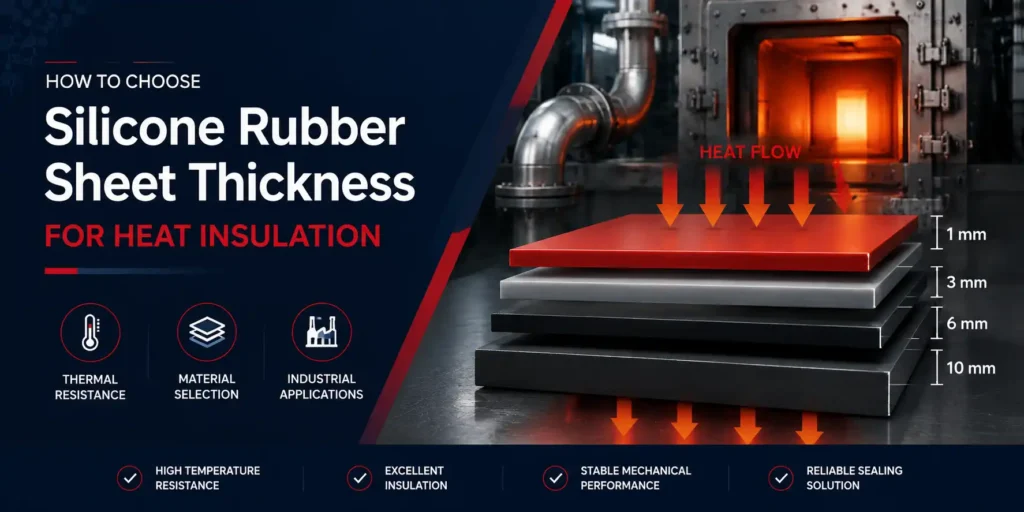
| Thickness | 1–3 mm (solar, electronics), 3–8 mm (glass, wood, composites) | Thicker sheets offer better cushioning and conformability for textured surfaces, but may slightly slow heat transfer. |
| Hardness (Shore A) | 50A – 65A | Softer (50A) for highly contoured parts; harder (65A) for high precision and less deflection on flat panels. |
| Temp. Range | Ensure it exceeds your process temperature by a 20-30°C safety margin. | Prevents premature aging and cracking. |
| Surface Finish | Smooth, Matte, Textured (Anti-Slip) | Textured surfaces are recommended for preventing material slip, especially on inclined or vertical press faces. |
| Reinforcement | Fabric Mesh (Fiberglass or Polyester) Backing | Strongly recommended for large sheets and high-vacuum applications. Dramatically improves tear resistance, dimensional stability, and handling. |
| Sheet Size | Custom-cut to your platen size (available up to 1.8m x 4m+) | A perfect fit eliminates fold-over issues and vacuum leaks at the edges. |
Maintenance Tip: Wipe down with a soft cloth and neutral pH cleaner after cycles to remove any residual film. Avoid sharp tools near the sheet. Regularly inspect for nicks, cuts, or permanent deformation.
Troubleshooting Common Lamination Issues
| Issue | Likely Cause | Solution |
|---|---|---|
| Persistent Air Bubbles | Aged sheet losing elasticity, cut or nick in sheet, contaminated surface. | Replace sheet (typical end of life: 2500-3500 cycles). Inspect for and seal minor cuts with high-temp RTV silicone. Clean thoroughly. |
| Marks/Imprints on Product | Debris trapped under sheet, sheet hardness too high for application, localised overheating. | Clean environment and sheet. Consider a softer hardness grade. Ensure platen temperature is even. |
| Poor Edge Seal / Vacuum Leak | Sheet is over-stretched, worn edges, sharp corners on fixture/mold. | Use a reinforced sheet. Ensure mold edges have a minimum radius. Re-cut sheet to proper size. |
| Slow Process Heating | Sheet is excessively thick for the heater power. | Switch to a thinner, thermally optimized grade if product allows. |
Industry Trends (2026): The Expanding Horizon
- 🌞 Renewable Energy: Driving demand for larger-format, high-temperature sheets for next-gen solar modules and BIPV (Building-Integrated Photovoltaics).
- 🏢 Advanced Architecture: Growth in laminated smart glass (electrochromic, PDLC) and ultra-thin decorative panels.
- 🚗 Automotive Evolution: Increased use for lightweight composite parts and synthetic leather lamination in EV interiors.
- 💻 Electronics Miniaturization: Critical for precise, clean-room compatible lamination of flexible displays, wearable electronics, and advanced semiconductor packages.
- 🪵 Sustainable Furniture: Demand for efficient, defect-free lamination of recycled materials and bio-based veneers.
Silicone sheets are increasingly replacing traditional materials due to their unmatched durability, sealing reliability, and ability to enable more complex and efficient manufacturing processes.
The Lsane Advantage: Engineered for Performance
As a specialist manufacturer of industrial silicone rubber sheets, Lsane provides tailored solutions trusted by vacuum press operators worldwide.
| Lsane Strength | Your Benefit |
|---|---|
| Vertical Manufacturing | Full control from compound mixing to curing ensures batch-to-batch consistency and traceability. |
| Extended High-Temp Grades | Formulations stable up to 300°C for the most demanding processes without hardening or cracking. |
| Comprehensive Reinforcement Options | From standard grades to heavy-duty fabric mesh-backed sheets for every machine and challenge. |
| Custom-Cut to Size | Precisely die-cut sheets up to 1.8m x 4m minimize waste and installation time. |
| Technical & OEM Support | Expert guidance on selection and full OEM branding/packaging services available. |
| Global Compliance | Materials comply with relevant FDA, RoHS, and ISO 9001 standards for assured quality. |
For solar panel manufacturers, architectural glass laminators, or high-tech electronics producers, Lsane sheets deliver the resilience, consistency, and longevity required for competitive, high-yield production.
Frequently Asked Questions
Q1: What is the typical service life of a silicone sheet?
A: Under standard operating conditions (≤180°C, proper handling), expect 2,500 to 3,500 cycles. Life varies with peak temperature, pressure, and material being laminated.
Q2: Can I use any high-temperature silicone sheet?
A: No. Vacuum lamination-grade silicone is specifically engineered for superior compression set, vacuum sealing, and continuous flex-fatigue resistance. Standard sheets may degrade quickly or fail to seal.
Q3: When is an anti-slip or reinforced sheet necessary?
A: Anti-slip texture is key for vertical presses or laminated materials with low surface friction. Reinforcement with fabric mesh is highly recommended for all large-format applications and any process where edge tearing or stretching is a concern.
Q4: Do you support custom orders and global shipping?
A: Yes. Lsane specializes in custom formulations, sizes, and hardness. We provide complete OEM/ODM services, including private labeling, and support international shipping with all necessary documentation.
The Foundation of Flawless Lamination
The silicone sheet is far more than a simple consumable—it is the critical process enabler. It is the key to achieving the perfect vacuum seal, the mirror-like surface finish, the uniformly strong bond, and the reliable thermal protection for your product.
Investing in the right silicone sheet is investing in the heart of your laminating process. It safeguards your product quality, maximizes your equipment uptime, and optimizes your total operational cost.
Ready to optimize your vacuum lamination process? Contact Lsane today to discuss your application requirements. Explore our range of high-performance, customizable silicone sheets—engineered to excel in your most demanding production environments.