A molded silicone sealing gasket used in electronic communication equipment must protect more than a simple opening. In telecom junction boxes, cable entry areas, outdoor cabinets, and communication enclosures, a gasket may need to seal multiple cable channels, resist moisture, maintain compression recovery, and remain stable in cold, humid environments.
Today’s product is a custom-molded black silicone sealing component for the electronics communications field. It is produced by mold compression forming, with process requirements for anti-mold and anti-aging performance. The target use environment is cold and damp, which means the part must be evaluated not only by shape, but also by material behavior, long-term sealing reliability, and environmental resistance.
Why Electronic Communication Equipment Needs Reliable Silicone Sealing
Electronic communication equipment often works in locations where temperature and humidity change quickly. Outdoor junction boxes, base station accessories, control cabinets, signal transmission housings, and cable management systems may face rain, condensation, frost, dust, vibration, and long periods of compression. If a sealing gasket loses shape or allows moisture to enter, the final equipment may face corrosion, signal instability, insulation risk, or maintenance problems.
This is why buyers do not select a custom silicone gasket only by appearance. A telecom seal must fit the housing, match the cable diameter, compress correctly, and recover after long-term loading. The material must also resist aging caused by moisture, ozone, temperature cycling, and outdoor exposure.
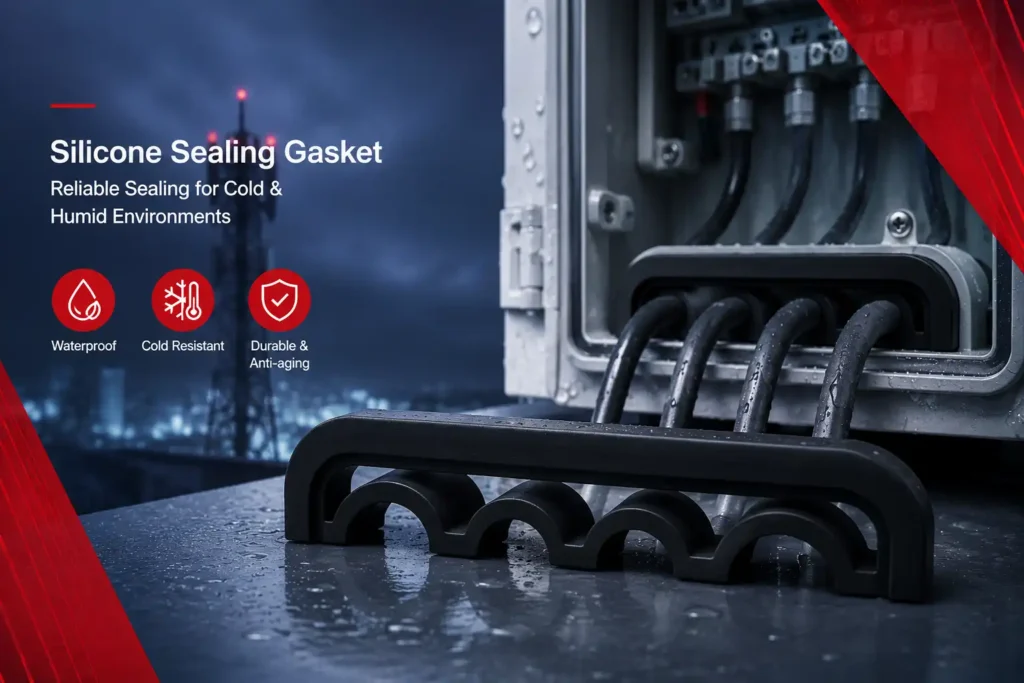
The product shown in this article has a multi-channel profile. The curved grooves suggest that it is designed to hold or seal cable paths inside a junction box or communication enclosure. This kind of geometry is difficult to replace with a flat gasket. The sealing surface, groove radius, wall thickness, and compression zone all need to be shaped by tooling. That is why mold compression forming is a practical process for this kind of custom component.
For B2B buyers, the most important question is not just “Can the supplier make this shape?” A better question is: can the supplier make the same shape repeatedly, with the right material properties, while meeting the project’s moisture, mold, aging, and environmental requirements?
Why Use Mold Compression Forming for This Silicone Sealing Component?
Mold compression forming is a common production method for many silicone molded parts. In this process, silicone rubber compound is placed into a mold cavity, then heat and pressure are applied so the material fills the cavity and cures into the required shape. For cable holder seals, junction box gaskets, thick silicone pads, and irregular sealing components, compression molding can be a strong choice.
Compared with cutting from flat sheet, compression molding can form three-dimensional features. These may include half-round cable grooves, raised sealing lips, rounded edges, integrated ribs, mounting shoulders, and complex cross-sections. In the uploaded product image, the repeated semicircular grooves and base frame are exactly the type of geometry that benefits from a mold.
Compression molding also supports customization. If the customer provides drawings, samples, cable diameter information, enclosure dimensions, or compression requirements, the mold can be designed around the actual use case. This is important in the electronic communication field because a standard seal may not fit every junction box, cable layout, or enclosure design.
For a cold and humid use environment, molding quality must be controlled carefully. Poorly cured material, uneven flash trimming, weak edges, or dimensional variation can reduce sealing performance. A good supplier should evaluate tool design, material flow, curing condition, demolding, trimming, and final inspection before approving production.
What Makes Cold and Humid Environments Challenging?
A cold and humid environment is difficult for many sealing materials because several stresses happen at the same time. Low temperature can reduce flexibility. Moisture can enter small gaps. Condensation can form inside sealed boxes when temperature changes. If the gasket does not compress evenly, water vapor can slowly reach sensitive components. If the material ages, cracks, hardens, or loses recovery, the seal may become weaker over time.
Silicone rubber is often used in these conditions because it has a broad temperature range and good weathering resistance. It can remain flexible in cold conditions better than many general-purpose rubbers. It also resists ozone and aging, which matters when equipment is exposed to outdoor air or long service cycles.
However, material choice alone is not enough. A molded silicone sealing gasket must be designed for the real assembly. The cable grooves should match the cable size. The base should sit correctly in the junction box. The compression zone should be neither too loose nor too tight. If the gasket is over-compressed, it may deform permanently. If it is under-compressed, it may not seal. In cold and damp environments, those small design errors can become larger field problems.
For this reason, buyers should provide environmental details early. Useful information includes working temperature range, expected humidity, exposure to rain or condensation, indoor or outdoor use, cable size, enclosure material, compression gap, installation method, and whether the product needs anti-mold testing or special aging validation.
Anti-Mold and Anti-Aging Requirements: What Buyers Should Clarify
The product requirement includes anti-mold and anti-aging performance. These are important but broad terms. To make them useful in manufacturing, they should be translated into practical material and test requirements.
Anti-mold requirement
Anti-mold performance is important when a gasket is used in damp, enclosed, or poorly ventilated conditions. Telecom junction boxes may contain moisture from rain, condensation, or cable entry areas. If the environment remains damp for long periods, the customer may want a silicone material and process that reduce mold growth risk.
In production, anti-mold requirements may involve material selection, compound cleanliness, curing control, storage, and packaging. The exact level should be confirmed by the buyer’s standard. If the customer has a specific test method, such as a fungal resistance test or internal environmental aging standard, that requirement should be shared before sampling. Without a defined test method, “anti-mold” can be interpreted differently by different suppliers.
Anti-aging requirement
Anti-aging performance is about whether the gasket can keep useful properties after time, temperature, moisture, ozone, and compression. In telecom applications, the part may stay compressed for years. A gasket that becomes brittle, cracks, or loses recovery can no longer protect the enclosure properly.
Silicone is a good candidate because it generally has strong resistance to weathering, ozone, and temperature change. Still, the final performance depends on compound grade, hardness, curing quality, part design, and working conditions. If the application is critical, buyers should confirm aging test conditions, compression set requirements, and any project-specific lifetime expectations.
Recommended Specifications for a Telecom Silicone Sealing Gasket
When requesting a quote for custom silicone rubber parts used in communication equipment, a clear specification helps the supplier recommend the right material and process. The following table shows the main items that should be confirmed.
| Specification | Why it matters | Recommended buyer input |
|---|---|---|
| Application | Defines sealing risk and environment | Telecom junction box, cable entry seal, outdoor cabinet, enclosure gasket |
| Manufacturing process | Affects geometry, tolerance and repeatability | Mold compression forming |
| Material | Controls flexibility, aging resistance and sealing behavior | Silicone rubber compound selected for cold and humid use |
| Hardness | Affects compression, recovery and cable fit | Define Shore A target and tolerance |
| Cable groove size | Determines whether the seal fits the cable diameter | Provide cable OD, groove radius, compression condition |
| Anti-mold requirement | Important for damp or enclosed environments | Provide required test method or acceptance standard |
| Anti-aging requirement | Important for long-term sealing reliability | Define aging test, temperature, time and performance target if available |
| Color | Affects appearance and product identification | Black or custom color according to project requirement |
| Packaging | Helps protect surface cleanliness before installation | Bulk pack, bagged pack, labeled batch pack, or custom packaging |
If the seal is part of a cable management system, it may also need to work with silicone extruded profiles, silicone strips, or other enclosure sealing parts. If the project begins with a sheet material and is later converted into a flat gasket, buyers can also review silicone rubber sheets to understand available base material options.
How LSAN Would Approach Sampling and Production
For a custom molded silicone sealing gasket, LSAN would begin by reviewing the part drawing or physical sample. If the customer only has a photo, the first step is to confirm the application, cable sizes, enclosure dimensions, hardness requirement, and environmental performance needs. A photo can help identify the product type, but it cannot replace full engineering data.
The next step is material selection. Because this product is intended for cold and humid environments, the silicone compound should be selected for flexibility, aging resistance, and stable compression behavior. If anti-mold performance is required, the requirement should be translated into a test method or buyer acceptance condition before the supplier makes the sample.
Then the mold design should support the sealing function. For a multi-groove cable seal, the groove geometry and base frame dimensions are not decoration. They directly affect how the part holds cables, compresses, and seals. Tooling should consider material shrinkage, demolding, edge strength, flash line position, and trimming access.
After molding, the part should be inspected for surface defects, incomplete filling, excessive flash, wrong dimensions, visible cracks, deformation, and inconsistent hardness. For critical telecom equipment, sampling should include installation testing inside the real enclosure. A seal that looks good on a table may still fail if the compression gap or cable fit is wrong.
Common Mistakes When Sourcing Telecom Silicone Seals
Using a generic gasket for a custom cable layout
A flat gasket or standard strip may not match a multi-cable junction box. If the cable grooves are not designed for the actual cable diameter, sealing pressure may be uneven.
Ignoring compression set
In long-term use, a gasket may remain compressed for months or years. Buyers should consider compression recovery, especially for outdoor or remote equipment that is hard to maintain.
Not defining anti-mold testing
Anti-mold is a useful requirement, but it needs a standard. Without a test method, suppliers and buyers may have different expectations.
Approving samples without installation testing
A molded seal should be tested inside the actual enclosure with the intended cables. Visual inspection alone is not enough for a sealing part.
FAQ: Molded Silicone Sealing Gaskets for Telecom Equipment
What is a molded silicone sealing gasket?
A molded silicone sealing gasket is a custom rubber part made in a mold to match a specific sealing shape. It can include grooves, ribs, cable channels, lips, and non-standard geometry that cannot be achieved easily by cutting from flat sheet.
Why use silicone for telecom enclosure seals?
Silicone is used because it can remain flexible, resist aging, handle temperature changes, and support sealing in outdoor or damp environments. It is suitable for many telecom enclosures, junction boxes, and cable sealing applications.