
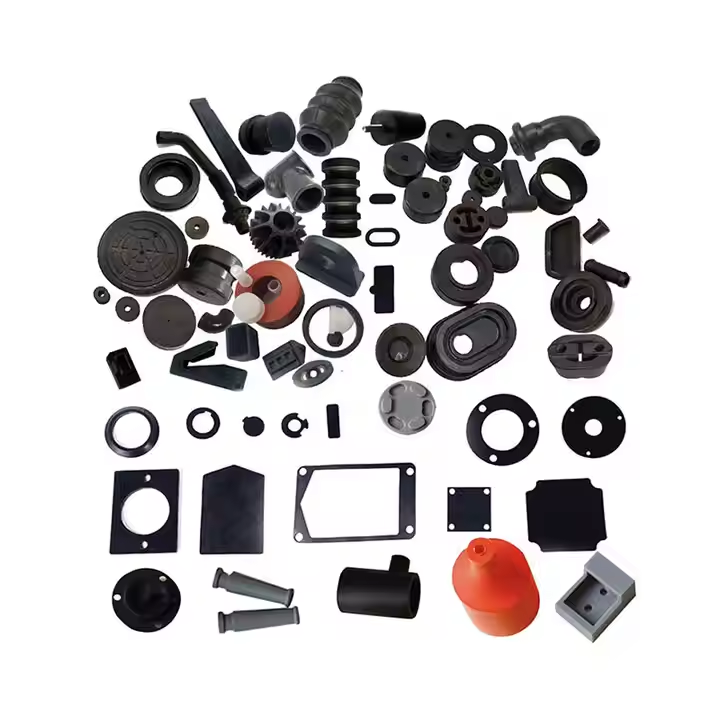
LSAN supplys moulded components manufactured using a range of silicone rubber material types. Solid silicone rubber mouldings are generally bespoke shapes often with complex profiles, a ribbed/textured finish or may require a lip or curved edge – for these reasons mouldings can not simply be pressed from sheet material and require specialist machinery.
All our Silicone Rubber Mouldings are made to order and are produced using a combination of samples or drawings provided by our customers, from which a tool or moulded cavity can be made. Silicone rubber mouldings can be taken in an endless number forms including feet, buttons, housings and cases, , screws, combs, tubes and o-rings to name a few, all designed to provide protection, prevent the leakage or ingress of air, fluid or gas and to be aesthetically pleasing.
Silicone molds not only have the advantage of producing various shapes and sizes, but also can meet the special requirements of customers, such as color, material, etc., to meet the needs of different customers for various standards.
Black, translucent, white, red, blue
Available in 20° - 80° shore
-40℃ to +200°C (230°C intermittent)
UV, oxidation, ozone, weathering, corona discharge, radiation
Used in a multitude of industries including automotive, catering (food & drink), electronics, pharmaceutical, insulation
Silicone (SI) rubber mouldings are produced using raw molten rubber compound and a mould or ‘die’ in which the rubber profile is formed and cured (set). Silicone (SI) rubber mouldings are available in a range of grades, hardnesses and colours, each with its own set of characteristics, properties and resistances to suit different exposures and environments – each produced using one of the techniques below:
Customers often choose silicone rubber mouldings as the material has a list of excellent characteristics and features, silicone rubber has a broad working temperature range of (-40℃ to +200°C) for use in hot and cold environments, with high temperature versions also available for extreme heat.
Silicone rubber mouldings are resistant to ozone, weathering, sea water, many chemicals and fungal growth, they also offer excellent tensile strength, tear resistance and electrical insulating properties.
Solid silicone rubber mouldings are available in a range of colours and hardnesses (the shore hardness is measured using a shore durometer which indicates the level of resistance to indentation ,the higher number on the scale indicate a greater resistance – harder the material/lower number indicate less resistance- softer the material). The material is also manufactured in different grades which add extra properties for use in specific applications such as high temperatures, food and flame retardancy.
Advanced Seals & Gaskets has a network of material manufacturers and suppliers, giving our customers more choice when looking for moulded silicone products, our most popular grades being:
FDA approved and suitable for working conditions up to 300°C
all general purpose silicone are certified for use within food, drink & pharmaceutical applications
used to detect metal fragments
this material offers the same mechanical properties as standard silicone, but with an improved fuel and mineral oil resistance.
this non-yellowing translucent material offers a high tear strength and does not produce any peroxides or ketones.
is a carbon filled silicone which conducts a low electrical amperage
offers a more superior flame retardance, meeting the following standard for railways BS6853 Cat1A and French Norm NFF 16-101 (now superseded by TS EN 45545-2)
Resistant to weathering, UV, ozone and chemicals
Can be used in food and pharmaceutical applications
Available in a choice of colours, hardnesses and grades
Bespoke profiles available in small or large quantities
Flame retardancy and electrical insulating properties
Can be used to produce variations of the same product for trials
Thank you for choosing us. Your inquiry has been assigned to a dedicated project engineer who will contact you within 24 hours with a tailored solution. Please check your email for the confirmation details.
For instant assistance regarding your silicone project, click here to WhatsApp us directly.