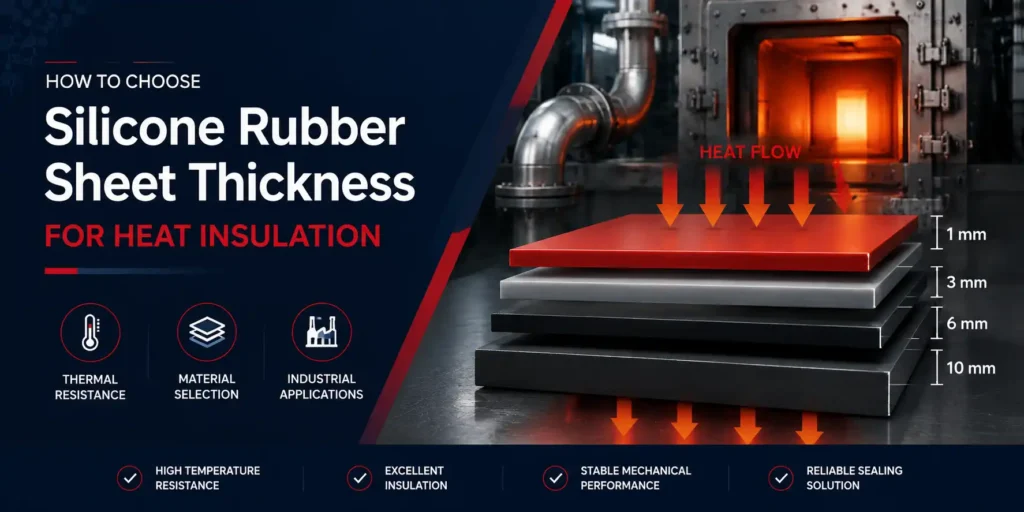
Choosing the right silicone rubber sheet thickness for heat insulation is not simply about selecting a thicker material.
A common mistake in industrial applications is assuming that a thicker silicone sheet always provides better thermal protection. In reality, insulation performance depends on many factors, including material structure, thermal conductivity, operating temperature, compression condition, heat bridges, and the final assembly design.
For example, a 6 mm silicone rubber sheet may perform well in one application but fail in another because:
- The hot-side temperature exceeds the material’s continuous-use limit
- Metal fasteners create heat transfer paths
- The sheet is compressed beyond its recommended range
- A solid silicone sheet is selected where silicone foam would be more suitable
Before choosing thickness, engineers and purchasing teams should first define the actual thermal requirement.
Is the silicone sheet designed to:
- Reduce heat transfer?
- Protect nearby components?
- Seal a high-temperature flange?
- Provide electrical insulation?
- Cushion thermal expansion?
- Combine sealing and insulation functions?
The correct thickness is the result of thermal calculation, material selection, and application validation — not the starting assumption.
For industrial buyers looking for reliable material solutions, working with an experienced silicone-rubber-sheets can help evaluate thickness, hardness, temperature resistance, and processing requirements together.
What Thickness of Silicone Rubber Sheet Is Best for Heat Insulation?
There is no universal “best” silicone sheet thickness for thermal insulation.
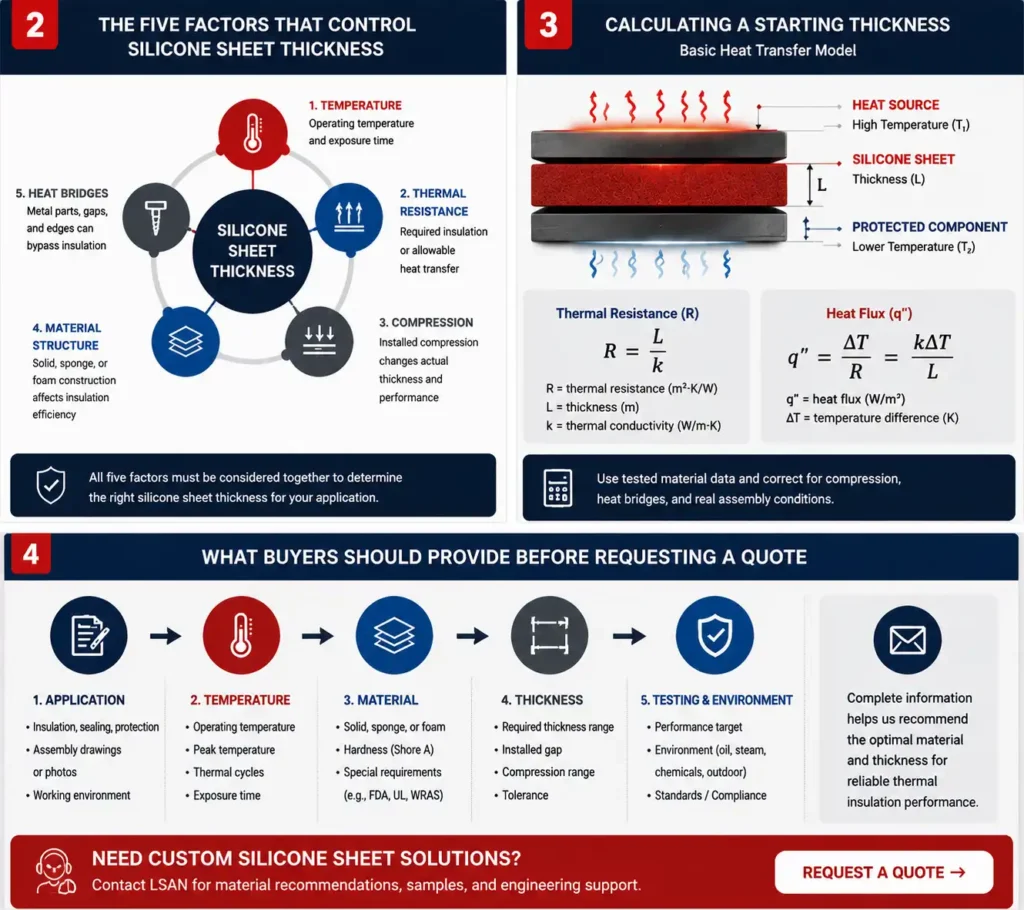
The correct thickness depends on:
- Operating temperature
- Required thermal resistance
- Thermal conductivity of the material
- Available installation space
- Compression condition
- Mechanical load
- Environmental exposure
A standard thickness such as 1 mm, 3 mm, 5 mm, or 10 mm does not automatically determine insulation performance.
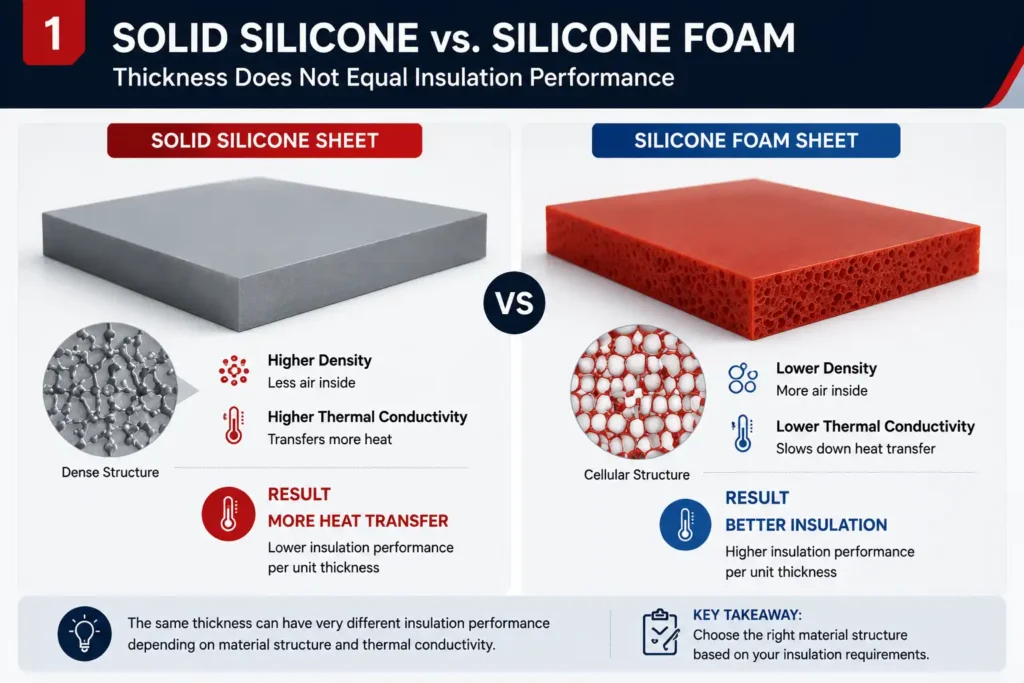
The material structure is equally important.
For example:
| Material Type | Thermal Performance | Typical Application |
| Solid Silicone Sheet | Good durability and sealing | Gaskets, protection pads, insulation barriers |
| Silicone Sponge Sheet | Better insulation performance | Heat sealing, cushioning, enclosure insulation |
| Silicone Foam Sheet | Higher insulation per thickness | Thermal barriers, gap filling |
| Thermal Conductive Silicone | Transfers heat | Heat dissipation applications |
This means a thinner silicone foam sheet may provide better insulation than a thicker solid silicone sheet.
Heat Resistance vs Thermal Insulation: Understand the Difference
Many buyers confuse these two concepts.
Heat Resistance
Heat resistance describes whether silicone can survive high temperature without:
- Cracking
- Hardening
- Losing elasticity
- Increasing compression set
- Reducing mechanical strength
Thermal Insulation
Thermal insulation describes how effectively a material reduces heat transfer.
A silicone material may survive 250°C but still transfer heat efficiently.
On the other hand, silicone foam may provide better insulation because its cellular structure reduces heat transfer.
Therefore:
High temperature resistance ≠ High thermal insulation performance
Before selecting thickness, define your actual thermal objective.
Example:
Reduce heat transfer from a surface operating at ___°C while maintaining the protected component below ___°C.
Five Factors That Determine Silicone Sheet Thickness Selection
1. Operating Temperature and Heat Exposure
Temperature is the first factor.
Before selecting silicone thickness, confirm:
- Normal operating temperature
- Maximum continuous temperature
- Short-term peak temperature
- Thermal cycle frequency
- Expected service life
A silicone sheet near:
- Industrial ovens
- Heating equipment
- Thermal processing machines
- Engines
- High-temperature pipes
may require a different material grade compared with normal sealing applications.
Related:
→ High Temperature Silicone Rubber Sheet Guide
2. Required Thermal Resistance
Thickness affects thermal resistance, but only together with thermal conductivity.
The basic relationship is:
Higher thickness + Lower thermal conductivity = Better insulation performance
However, real industrial assemblies also include:
- Metal brackets
- Screws
- Edges
- Adhesive layers
- Air gaps
These can create heat transfer paths.
Therefore, thickness calculation should always consider the complete assembly.
3. Material Structure: Solid Silicone vs Silicone Foam
Choosing the correct silicone structure is often more important than choosing thickness.
Solid Silicone Rubber Sheet
Advantages:
- Excellent mechanical strength
- Good tear resistance
- Stable dimensions
- Suitable for sealing
Applications:
- Industrial gaskets
- Protective layers
- High-temperature seals
Silicone Sponge Sheet
Advantages:
- Lower thermal conductivity
- Better compression flexibility
- Lightweight
Applications:
- Thermal insulation pads
- Equipment doors
- Heat protection systems
Silicone Foam Sheet
Advantages:
- Higher insulation efficiency
- Low compression force
Applications:
- Thermal barriers
- Gap filling
- Heat shielding
Related:
→ Silicone Sponge Sheet Solutions
4. Compression Changes Real Thickness
The installed thickness is not always the original thickness.
Example:
A 6 mm silicone foam sheet compressed to 4.5 mm will have:
- Different thermal resistance
- Different contact area
- Different heat transfer behavior
Excessive compression may:
- Reduce insulation performance
- Damage cellular structure
- Increase heat transfer
- Create permanent deformation
Therefore, suppliers should provide:
- Compression data
- Compression set
- Recommended compression range
- Thickness tolerance
5. Heat Bridges and Assembly Design
A thick silicone sheet cannot compensate for poor design.
Common heat bridges include:
- Metal screws
- Aluminum frames
- Mounting brackets
- Open edges
- Cable holes
- Uneven sealing surfaces
For critical applications, engineers should test the complete assembly instead of evaluating the silicone sheet alone.
How to Select Silicone Sheet Thickness Step by Step
Define the Thermal Requirement
Prepare:
- Hot-side temperature
- Protected-side temperature limit
- Contact area
- Available space
- Operating cycle
Choose the Material Type
Choose:
Solid silicone
When you need:
- Mechanical strength
- Sealing
- Durability
Silicone foam/sponge
When you need:
- Better insulation
- Cushioning
- Gap filling
Confirm Technical Data
Ask the supplier for:
- Thermal conductivity
- Temperature rating
- Thickness tolerance
- Compression performance
- Test method
Prototype and Validate
Before mass production:
Check:
- Surface temperature
- Protected component temperature
- Compression condition
- Thermal cycling
- Material aging
A real assembly test is more reliable than selecting thickness only from a catalog.
Common Silicone Sheet Thickness Selection Mistakes
Choosing Thicker Is Always Better
A thicker sheet may cause:
- Assembly problems
- Excessive compression
- Higher cost
- Dimensional interference
Using Temperature Rating as Insulation Rating
A silicone sheet rated for 250°C does not automatically block heat.
Temperature resistance answers:
“Can the material survive?”
Thermal insulation answers:
“How much heat passes through?”
Ignoring Compression
Especially for silicone foam and sponge materials.
Compression changes:
- Thickness
- Density
- Thermal performance
Selecting Material by Color
Color does not determine:
- Temperature resistance
- Thermal conductivity
- Material quality
- Compliance
Always specify technical requirements.
What Information Should Buyers Provide When Requesting Silicone Sheet Quotes?
To receive an accurate recommendation, provide:
| Requirement | Example |
| Application | Heat insulation / sealing / protection |
| Temperature | Continuous and peak temperature |
| Thickness | Required thickness range |
| Material | Solid silicone / sponge / foam |
| Hardness | Shore A requirement |
| Size | Sheet dimension |
| Compression | Installed gap |
| Environment | Oil, steam, chemicals, outdoor |
| Quantity | Sample or production volume |
For customized solutions, suppliers should also evaluate:
- Cutting requirements
- Adhesive backing
- Surface finish
- Special tolerance
FAQ
Is a thicker silicone sheet always better for heat insulation?
No. Thickness improves thermal resistance only when combined with suitable thermal conductivity and correct installation conditions.
Is silicone foam better than solid silicone for insulation?
Usually, silicone foam provides better insulation per thickness because its cellular structure reduces heat transfer. However, solid silicone may be better when mechanical strength and sealing performance are required.
What silicone sheet thickness is suitable for high-temperature applications?
The correct thickness depends on temperature, insulation target, compression, and assembly design. Testing is recommended before production.
Can silicone rubber sheets be used for industrial heat insulation?
Yes. Silicone sheets are commonly used for heat protection, sealing, insulation pads, and high-temperature equipment applications.
Choosing silicone rubber sheet thickness for heat insulation requires more than selecting a thicker material.
The correct solution depends on:
- Temperature conditions
- Thermal conductivity
- Material structure
- Compression
- Heat bridge control
- Real application testing
For industrial applications, the best silicone sheet is not the thickest option — it is the one that provides the required thermal performance while maintaining mechanical reliability and long-term stability.
When sourcing silicone rubber sheets for heat insulation, provide your application details, drawings, temperature requirements, and installation conditions. A professional supplier can help select the right material structure and thickness for your project.