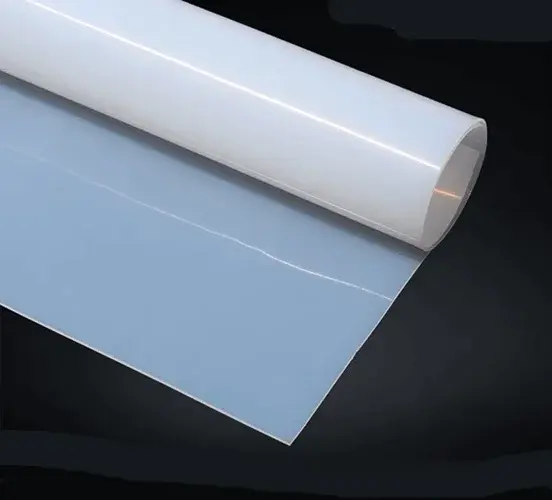
Every rubber gasket on a food or pharmaceutical line is wearing out, and most of them are wearing out invisibly. Scrapers, oven door seals, flange gaskets, and valve seats shed fragments as they age, and a fragment that reaches the product stream becomes a foreign body incident, a held batch, or in the worst case, a market recall. Standard silicone cannot be found by the metal detectors and X-ray systems already installed on the line, so the fragment passes every check. A metal-detectable silicone rubber sheet closes that gap.
A metal-detectable silicone rubber sheet is a food-contact silicone compound filled with a food-safe ferromagnetic additive, so any fragment that breaks off a gasket, scraper, or seal can be caught by inline metal detectors, X-ray inspection, or magnetic separation, while the sheet retains the full temperature range, steam resistance, and compliance of standard silicone. Choose it wherever rubber touches product on a food or pharma line, verify detectability on your own equipment before accepting the material, and specify detectable nitrile instead where the line runs in oils below 90°C.
The sections below explain how detectable silicone works, why auditors expect it, how it compares with detectable nitrile, where it belongs on real equipment, and how to specify and verify it.
What Is a Metal-Detectable Silicone Rubber Sheet
A metal-detectable silicone rubber sheet is standard food-grade silicone compounded with a uniformly distributed ferromagnetic powder, so even small fragments register on common inspection equipment, and the additive itself is selected to keep the whole compound compliant for food contact.
How the Detectable Additive Works
The sheet is not metal-filled in the structural sense. An ultra-fine, food-safe ferromagnetic powder is dispersed evenly through the silicone during compounding, so every fragment cut or torn from the sheet carries enough of the additive to produce a signal. Well-formulated compounds remain detectable at fragment sizes of roughly 2 mm and above, and the powder loading is small enough that the base polymer keeps its elasticity, sealing behavior, and compliance. Because the additive is distributed rather than coated, detectability does not wear off with the surface.
Three Detection Methods Compared
| Detection method | Principle | Best at catching | Practical note |
|---|---|---|---|
| Inline metal detector | Electromagnetic balance disturbed by ferrous content | Ferrous fragments, small sizes | Sensitivity depends on aperture size and product effect |
| X-ray inspection | Density difference against the product | Fragments in dense or wet product | Detects non-ferrous fillers too |
| Magnetic separators and rods | Direct magnetic attraction | Any ferrous fragment passing the separator | Passive protection, no operator decision needed |
The three methods are complementary, not alternatives. A fragment missed by the metal detector due to product effect may still be caught downstream by a magnetic trap or seen on the X-ray image.
Why Signal Blue Is the Standard
Detectable sheeting is normally produced in signal blue, a colour that seldom occurs naturally in food. That gives two independent layers of protection: optical sorters and human inspectors can spot a blue fragment that no sensor intercepts, and the colour doubles as an immediate visual cue during hygiene inspection. The pigment is part of the food-contact formulation, not an afterthought.
Why Food and Pharma Lines Need Detectable Elastomers
Worn rubber parts are one of the most common sources of foreign body contamination, and detectable elastomers convert that risk from a potential recall into a routine interception event, which is exactly what HACCP and GMP programmes expect a hazard analysis to address.
Where Fragments Come From
The most common sources of fragments are mechanical: scraper blades riding against product, oven and sterilizer door seals flexing on every cycle, flange gaskets under thermal cycling, and valve seats in continuous duty. Heat and chemistry accelerate the wear. CIP caustic and SIP steam run repeatedly, and age an elastomer far faster than the calendar suggests, which is why fragments often appear shortly after an intense cleaning or sterilisation campaign.
What HACCP and GMP Audits Expect
The HACCP framework requires hazards to be identified, assessed and controlled at defined points, and physical hazards sit alongside microbiological and chemical ones. Auditors increasingly ask two specific questions about elastomeric parts: what happens when this seal fails, and how would you know? A detectable material is one of the few answers that is built into the part itself rather than into a procedure that depends on operator diligence.
The Cost Asymmetry of One Missed Fragment
A recall is measured in batches, distribution scope and brand damage; the detectable grade is measured in a modest premium per sheet. The economics are not close, and they improve further once held shipments, investigation time and audit findings are counted. For lines running product directly against rubber, the premium usually pays for itself the first time a fragment is caught at the detector instead of in a customer complaint.
Detectable Silicone or Detectable Nitrile: Which Does Your Line Need
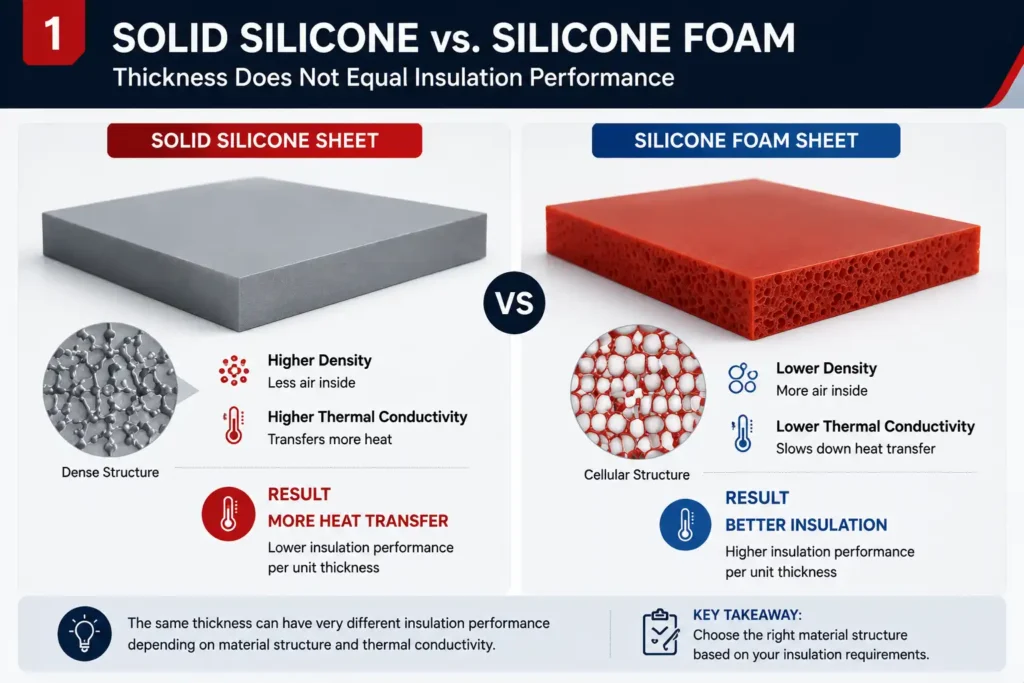
The decision rule is thermal and chemical: where the line runs hot, wet with steam or through CIP and SIP, choose detectable silicone; where the product is oily or fatty and temperatures stay below 90 C, choose detectable nitrile, because silicone swells in oil environments.
When Detectable Silicone Wins
Silicone keeps its flexibility from about minus 60 C to plus 200 °C continuously, shrugs off repeated steam sterilisation and resists the caustic and acid stages of cleaning regimes. Bakery equipment, sterilizer cabinets, hot syrup lines and aseptic filling blocks are its natural territory. Wherever heat or steam would destroy an NBR seal in weeks, detectable silicone is the only detectable option that lasts.
When Detectable NBR Is the Better Choice
Nitrile resists animal fats, vegetable oils, and petroleum-based soils far better than silicone, which swells in oil contact. Meat processing, sausage extrusion, and fryer-adjacent equipment below 90 C belong to detectable nitrile. Specifying silicone there buys worse service life for no gain in safety.
Side-by-Side Comparison
| Criterion | Detectable silicone (VMQ) | Detectable nitrile (NBR) |
|---|---|---|
| Continuous temperature | About -60 to +200 C | Up to about 90 C in service |
| Steam and CIP/SIP | Excellent | Limited |
| Oil and fat resistance | Poor, swells | Excellent |
| Food-contact compliance | FDA 21 CFR 177.2600 grades common | FDA grades common |
| Typical duty | Bakery, dairy, pharma, aseptic filling | Meat, oils, extrusion below 90 C |
| Typical failure mode | Heat ageing, compression set | Oil swelling avoided by correct selection |
Applications Across Food and Pharma Equipment
Any position where rubber contacts or is adjacent to product is a candidate, and the highest-value installations are the ones where fragments would be hardest to see and impossible to intercept by eye.
Bakery and High-Temperature Processing
Dough scraper blades, tunnel oven door seals and hot syrup transfer lines combine abrasion with heat, which makes them the fastest-wearing rubber parts in the plant. Detectable silicone sheets cut into scrapers and door gaskets keep fragments visible to the metal detector positioned before packing.
Dairy, Beverage, and Aseptic Filling
Flange gaskets, valve seals, and filler heads see repeated steam sterilization and aggressive CIP chemistry. Fragments here enter liquid product where visual inspection is useless, so detection equipment carries the whole burden and the material must support it.
Pharmaceutical Processing
Lines requiring USP Class VI materials use detectable grades compounded to the same standard, covering tubing supports, equipment seals and cleanroom gaskets. In pharma, the documentation matters as much as the material, and a batch-traceable, detectable sheet simplifies the quality file.
Specifying and Verifying the Sheet You Buy
A written specification with seven items, followed by a detection trial on the buyer’s own equipment, is what separates a compliant purchase from an assumed one, because detectability depends on the buyer’s detector settings and product as much as on the sheet.
What Belongs in the Specification
- Base compound and compliance level, for example FDA 21 CFR 177.2600 or USP Class VI, with the current FDA food-contact regulation referenced
- Hardness, typically 40 to 85 Shore A depending on duty
- Thickness and width, including tolerance
- Colour, normally signal blue
- Detection methods the compound supports: metal detector, X-ray, magnetic
- Minimum fragment size guaranteed to be detectable
- Test standard or method used to verify detectability
Verifying Detection on Your Own Line
Cut sample coupons from the supplied sheet, reduce them stepwise in size, and run them through the line’s own detector with real product passing alongside, since product effect changes the achievable sensitivity. Record the smallest fragment the system reliably rejects. That number, not the supplier’s catalogue figure, is the plant’s actual protection level, and it belongs in the HACCP file.
Documentation to Request
Ask for a certificate of analysis per batch, a food-contact or USP declaration covering the detectable additive as well as the base polymer, and batch traceability. A supplier who cannot document the additive is selling an ordinary blue sheet with a detectable story.
FAQ
Does adding metal powder change the silicone’s properties?
A correctly formulated compound keeps its elasticity, sealing behavior, and temperature range, though tear strength needs attention because the filler acts as a stress concentrator. Reputable grades are compounded specifically to preserve tear resistance, and hardness may rise slightly. Ask for tensile and tear figures measured on the detectable grade, not on the standard grade.
What is the smallest fragment a metal detector can actually find?
It depends on the detector aperture, the product effect, and the line speed, so there is no universal answer. Well-compounded detectable silicone is typically recoverable down to roughly 2 mm, but the only number that matters is what you measure on your own line with your own product, which is why the stepwise coupon trial is part of acceptance.
Is blue the only available color for detectable sheeting?
Signal blue is the industry standard because it rarely occurs in food and stands out to both optical sorters and operators, but grey and other shades exist for applications where blue would clash with product appearance. Whatever the color, confirm that the pigment is included in the food-contact declaration and that detectability is unchanged.